

Debt Avalanche vs. Debt Management Plan (DMP): See Both Paths Before You Pick One
The debt avalanche is a free payoff method you run yourself, at the interest rates you already have. A debt management plan (DMP) is a 3 to 5 year program a nonprofit agency runs for you, at negotiated rates that often land near 8%. Which one fits depends on whether your monthly budget can outrun your APRs, and Debt Payoff Planner can put both answers on screen: your avalanche plan with your real rates, and a second workspace previewing the reduced-rate version, side by side.
The short answer
If you can pay meaningfully more than your minimums, the avalanche usually wins. It is free, it minimizes interest, and you keep control of your accounts. If you are barely covering minimums on cards at 25%+ APR, payoff order stops mattering much; a DMP's negotiated rate cut is one of the few things that changes the math itself, and it is worth pricing out. The dividing line is cash flow, not willpower, and ten minutes of data entry in the app shows which side of it you are on.
What the debt avalanche is
The debt avalanche is a payoff order, not a product. You pay the minimum on every debt. Every extra dollar goes to the debt with the highest APR. When that debt is gone, its payment rolls into the next-highest APR. You repeat until you are debt-free. (Full walkthrough: the debt avalanche method. Comparing DIY orders instead? See snowball vs. avalanche.)
Key facts:
- It costs nothing. There are no fees, no enrollment, and no third party.
- Your interest rates do not change. The avalanche minimizes interest at the rates you already have.
- Your accounts stay open. Nothing unusual is reported to credit bureaus; it is just you making payments.
- You can pause or change strategy at any time. Nobody is monitoring you.
That freedom works best with feedback. A $100 extra payment feels much like a $400 one in the moment; the real difference shows up in your payoff date, and no bank statement shows you that. Tracking closes the loop: log the smaller payment in Debt Payoff Planner and your debt-free date moves on the home screen the same day, so you can decide right then whether next month goes back to $400.
What a debt management plan is
A debt management plan is a repayment program administered by a credit counseling agency, usually a nonprofit. The agency negotiates concessions with your credit card issuers. You then make one consolidated monthly payment to the agency, which distributes it to your creditors.
Key facts:
- Creditors typically cut interest rates to somewhere around 8%, sometimes lower. This is the entire value of the program. A card at 29% APR dropping to 8% changes what your monthly payment can accomplish.
- Programs run 3 to 5 years by design. Creditors agree to the concessions because the plan pays them in full within that window.
- Fees are small but real. Expect a setup fee (often $0 to $50, capped by state law) and a monthly fee (often $25 to $50). Reputable agencies waive fees for genuine hardship.
- Your enrolled cards are closed. This is a condition creditors impose, not a choice.
- A DMP is not a loan and not settlement. You repay 100% of what you owe, just at lower rates.
- Only unsecured debt qualifies, mostly credit cards. Auto loans, mortgages, and federal student loans cannot be enrolled.
The credit impact is more modest than people fear. A DMP is not reported as a negative mark the way settlement or bankruptcy is. Closing cards can dip your score at first, but years of on-time payments usually leave your credit healthier than it started.
Side-by-side comparison
| Debt avalanche | Debt management plan | |
| Cost | Free | Setup fee (~$0 to $50) plus monthly fee (~$25 to $50); interest still paid, but at reduced rates |
| Credit impact | None beyond normal payment history; accounts stay open | Enrolled cards are closed, which can dip scores initially; steady payments typically rebuild credit over the program |
| Control | Total; you set the order, the amount, and can change course anytime | Limited; one fixed payment, cards closed, terms set by the agency and creditors |
| Typical timeline | Depends entirely on how much extra you pay; 2 to 4 years is common with real extra payments, but nothing enforces it | 3 to 5 years by design, with a fixed end date |
| Who it suits | People with cash flow above minimums who want to keep control | People whose minimums nearly consume their available cash at high APRs, or who want external structure |
See both paths in Debt Payoff Planner before you decide
Previewing a DMP takes three steps in the app and requires no enrollment, no phone call, and no commitment.
1. Build your avalanche plan. Enter each debt; all the app needs is the balance, APR, and minimum payment. Choose the avalanche strategy and set your total monthly payment. You immediately get a step-by-step plan and your debt-free date. This is your DIY baseline, at the rates you actually have.
2. Preview a reduced-rate payoff. Create a second workspace and enter the same debts at the rate a DMP would negotiate (around 8% is typical). Give it the same monthly payment. Now you have a second debt-free date. You can also use the balance transfer tool to model moving high-APR balances to a lower rate, which answers a related question: whether a 0% transfer offer beats both.
3. Compare the two dates. If they are months apart, the avalanche is doing its job; run it yourself and keep the fees, the open accounts, and the control. If they are years apart, that gap is what a rate cut is worth to you, and it is a strong signal to get real quoted terms from a nonprofit agency before deciding.
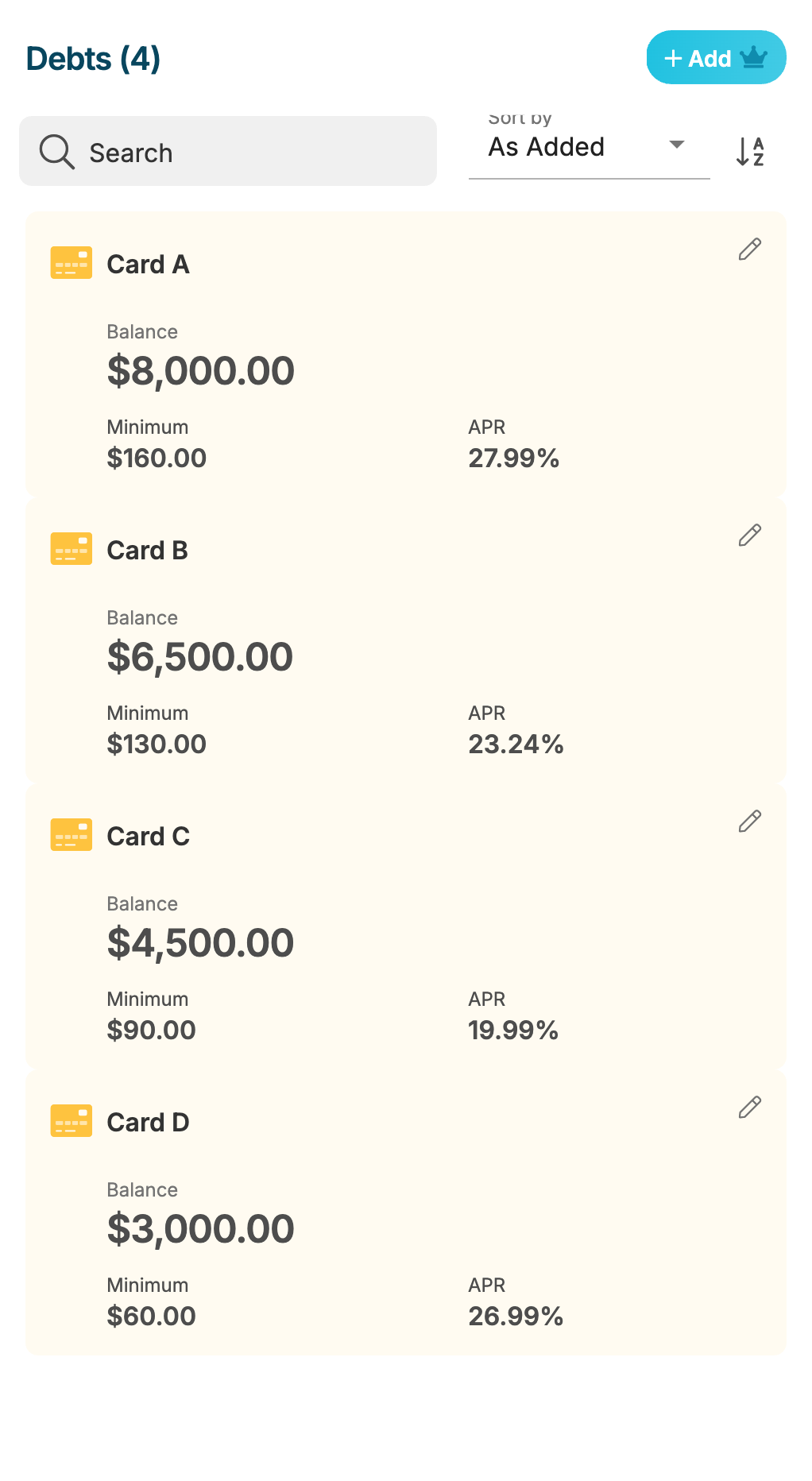
Here is what that comparison looks like with four typical cards totaling $22,000:
| Debt | Balance | APR | Minimum |
| Card A | $8,000 | 27.99% | $160 |
| Card B | $6,500 | 23.24% | $130 |
| Card C | $4,500 | 19.99% | $90 |
| Card D | $3,000 | 26.99% | $60 |
Minimums total $440 per month.
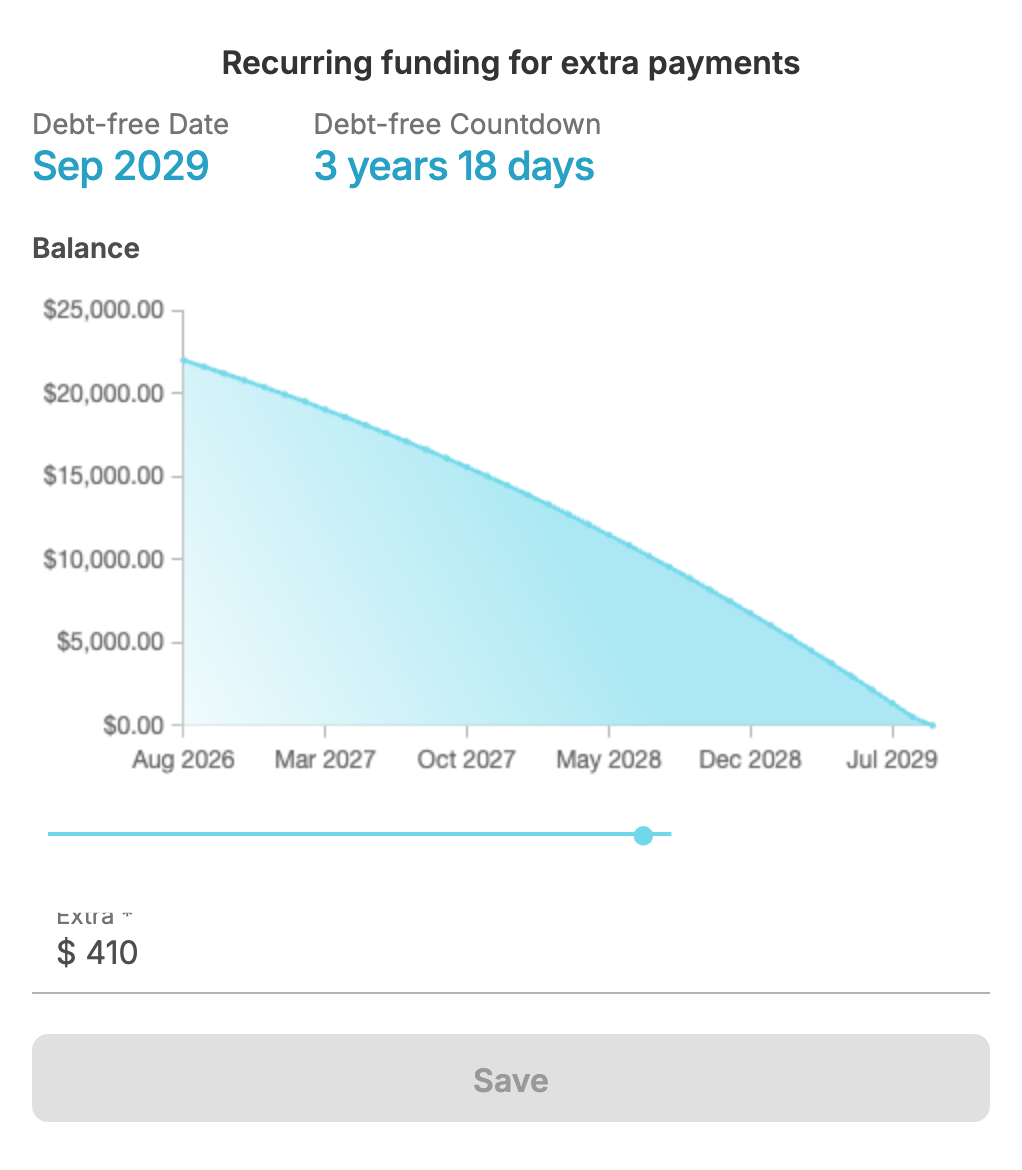
With $850 per month (about $410 above minimums), the two workspaces nearly agree:
| Avalanche workspace (your APRs) | 8% preview workspace | |
| Debt-free date | 37 months out | 29 months out |
| Total interest | ~$9,140 | ~$2,320 |
Here are both plan summaries, straight from the app:
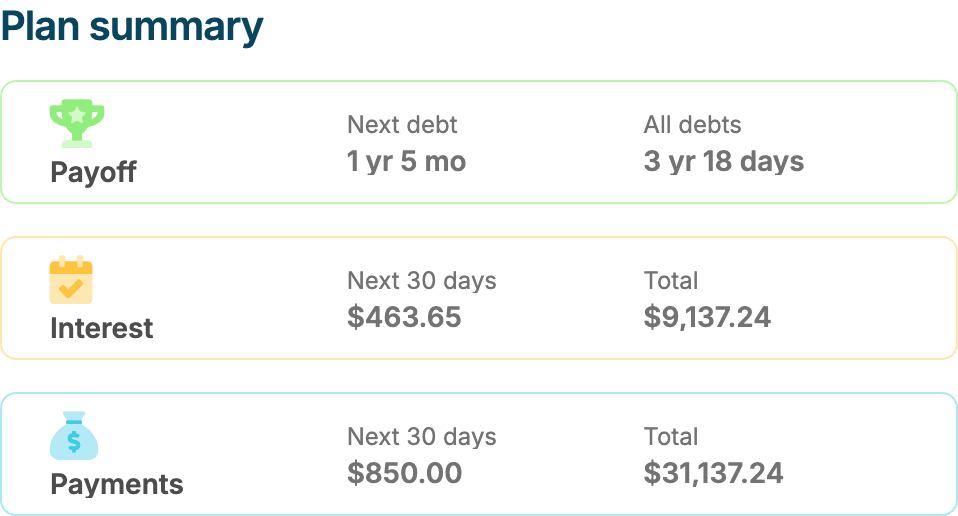
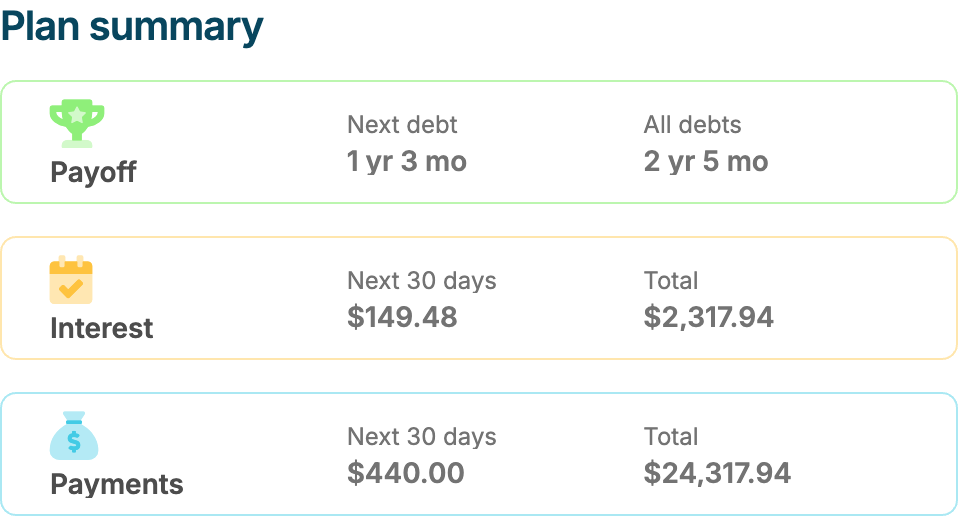
Eight months and $6,800 of interest, versus program fees, closed cards, and 3 to 5 years of someone else holding the wheel. Most people in this position run the avalanche themselves and put their energy into sticking to it.
With $480 per month (barely $40 above minimums), the gap widens to years:
| Avalanche workspace (your APRs) | 8% preview workspace | |
| Debt-free date | 12 years 5 months out | 4 years 7 months out |
| Total interest | ~$49,700 | ~$4,360 |
That is a nearly 8-year, $45,000 gap, and no payoff order closes it, because at 25%+ APRs a near-minimum payment mostly feeds interest. The workspace comparison also exposes the other lever: at $850 per month, the avalanche alone brings this same debt-free date within 37 months, no program required.
Who should choose which
Run the avalanche yourself if:
- Your avalanche workspace already shows a debt-free date within 2 to 3 years, or the two workspaces land within months of each other.
- You can consistently pay well above your minimums (in the example above, $700+ against $440 in minimums).
- You want your cards open and your plan under your control.
- You are ready to track the plan month over month, because nobody else will.
Price out a DMP if:
- Your two workspaces are years apart and you cannot realistically raise your monthly payment.
- Your balances are flat or growing even though you pay every month.
- You are getting collection calls or are close to missing payments. Agencies can sometimes re-age accounts and stop the spiral.
Pricing it out is free and obligates you to nothing. The first counseling session with a nonprofit agency quotes your actual negotiated rates, fees, and payment. Bring the numbers from your avalanche workspace and compare debt-free dates with real terms on both sides.
Neither is right if:
- You cannot cover your minimums at all, even at 8%. A counselor can tell you honestly whether bankruptcy is the better path, and a good one will.
- Most of your debt is secured (auto, mortgage) or federal student loans. Those debts have their own programs.
Can you switch between them?
Yes, in both directions.
- Avalanche to DMP: a stalled DIY attempt does not disqualify you. Your payment history in the app is exactly the evidence a counselor will ask about.
- DMP to DIY: you can leave a DMP at any time. You keep your progress; you lose the negotiated rates going forward. Some people exit early and finish the remainder as an avalanche once the balances are manageable.
The one-way door is card closure. Cards closed for a DMP do not reopen if you leave. Weigh that before enrolling.
Warning: a DMP is not debt settlement
Debt settlement companies advertise heavily and sound similar. They are not similar.
Settlement companies tell you to stop paying your creditors while money accumulates in escrow, then try to negotiate lump-sum payoffs for less than you owe. Along the way: your accounts go delinquent, your credit takes severe damage, creditors may sue, forgiven amounts can be taxed as income, and fees commonly run 15% to 25% of enrolled debt. Many people drop out worse off than they started. The FTC and CFPB have both taken repeated action against settlement firms.
A DMP repays your debt in full at reduced interest through a nonprofit. If a company promises to cut your balances or tells you to stop paying your creditors, it is settlement, whatever it calls itself.
To find a legitimate agency, start with NFCC (nfcc.org) or FCAA member agencies: nonprofit, accredited, certified counselors. The first session should be free, and all fees should be quoted in writing before you enroll.
Whichever path you pick, the plan only works if you stick to it
A DMP comes with built-in structure: one payment, a fixed end date, an agency watching. The avalanche does not. Its structure has to come from somewhere, and that is exactly what Debt Payoff Planner is built to be: the app that holds your plan and tracks it. Your step-by-step plan, your debt-free date, every payment logged against the plan, and your progress visible enough to celebrate, so drift shows up in weeks instead of months. You enter your debts manually; the app does not link to your bank and does not access your financial accounts. Over 2 million people have used it to keep a payoff plan alive past the motivated first month.
If your workspaces put you on the avalanche side, keep that plan and track it to the finish: get Debt Payoff Planner for iPhone and Mac.
If the gap pointed you toward a DMP, take your numbers to a free NFCC consultation and compare real terms. The app will still be here if you exit the program early and finish the payoff yourself.
Frequently asked questions
It can preview one. Create a second workspace with your debts at the rate a DMP would negotiate (around 8%) and compare debt-free dates against your avalanche plan. The balance transfer tool can model rate changes too. A real DMP's terms come from the agency's negotiation with your creditors, so treat the workspace as a preview and the agency's written quote as the real number.
Not directly. A DMP is not a negative mark like settlement or bankruptcy. Closing enrolled cards can dip your score at first, through higher utilization and lower average account age. Consistent on-time payments typically rebuild it, and many people finish a DMP with better credit than they started with.
When you can pay well above your minimums, usually yes: it is free, keeps your accounts open, and minimizes interest at your existing rates. When your budget barely clears minimums at high APRs, the DMP's rate cut can shorten payoff by years. The two-workspace comparison above shows you which situation is yours.
Not really, and you do not need to. A DMP replaces your per-card payments with one fixed payment the agency distributes. Extra money in a good month goes to the program and shortens the timeline. Avalanche ordering only matters when you control the individual payments.
No. A consolidation loan is new debt that pays off old debt, and it requires credit good enough for a decent rate. A DMP is not a loan; your debts stay where they are, at negotiated rates, with one payment routed through the agency.
Example figures were computed in Debt Payoff Planner with fixed minimum payments totaling $440 per month and extra payments applied to the highest APR first; the reduced-rate preview assumes all accounts at 8% APR. Your rates, minimums, and any agency's actual terms will differ. We are not financial professionals, and nothing here is official financial advice; it is information to help you run your own numbers with confidence.
Related

Debt Avalanche Method
The debt avalanche or ‘debt stacking’ method pays off your debts with the highest interest rates first. Unlike the debt snowball, which focuses on balances, the avalanche method focuses on interest rates.

Debt Snowball vs. Debt Avalanche
If you are looking to get out of debt as quickly as possible, you have two major strategies to choose from if you are looking for a general plan. The Debt

6 Ways to Up Your Financial Game Now That You’ve Got a Debt Payoff Plan
You've crushed your debt-free planning using Debt Payoff Planner. These six tips from debt payoff champ Kelly Blodgett are great next steps to consider.